Understanding Agent Fees in 2026: A 10-15% Transfer Guide

The standard for agent fees in 2026 football transfers typically ranges between 10-15% of a player’s gross earnings or transfer value, influenced by evolving FIFA regulations.
The world of football transfers is a whirlwind of negotiations, high stakes, and often, opaque financial dealings. One area that consistently garners significant attention and debate is the role and remuneration of player agents. As we look towards 2026, understanding agent fees 2026 transfers becomes crucial for clubs, players, and fans alike, especially with the established 10-15% standard.
The evolving landscape of agent regulations
The regulatory framework governing football agents has been in a constant state of flux, particularly over the past few years. FIFA, the sport’s global governing body, has made concerted efforts to bring greater transparency and control to agent activities, aiming to protect the integrity of the game and the welfare of players. These changes directly impact how agent fees are structured and perceived.
Historically, agent fees could be exorbitant and sometimes undisclosed, leading to accusations of conflicts of interest and unfair practices. The introduction of new regulations seeks to cap these fees and clarify who pays whom, fostering a more equitable environment for all parties involved in a transfer. These regulations are not just theoretical; they have real-world implications for every deal.
FIFA’s reintroduction of agent regulations
FIFA’s reintroduction of a licensing system for agents and a cap on their commissions marked a significant shift. This move, aimed at standardizing practices globally, has been met with mixed reactions but is largely seen as a necessary step towards greater accountability.
- Mandatory licensing exams for agents.
- Introduction of a clearing house for fee payments.
- Restrictions on dual representation to avoid conflicts.
The impact of these regulations in 2026 is expected to be fully realized, with clubs and agents having adapted to the new operational norms. This adaptation period has ironed out many initial challenges, leading to a more streamlined, albeit tighter, system for transactions. The ultimate goal remains to ensure fair play, not just on the pitch, but in the boardroom as well.
In conclusion, the regulatory environment for football agents is more structured than ever. These changes dictate the parameters within which agents operate, influencing everything from their negotiation power to the final fee percentages in transfer deals. Understanding this foundation is key to comprehending the 10-15% standard.
Breaking down the 10-15% standard for agent fees
The much-discussed 10-15% standard for agent fees in 2026 transfers isn’t a random figure; it’s a carefully considered range influenced by regulatory caps and market dynamics. This percentage typically applies to a player’s gross earnings over the contract duration or a portion of the transfer fee itself, depending on the specifics of the deal and who the agent represents.
For instance, if an agent represents a player, their fee is usually calculated as a percentage of the player’s salary. If they represent the buying club, it’s a percentage of the transfer fee. Dual representation, where an agent works for both player and club, is heavily scrutinized and often restricted to prevent conflicts of interest, with specific rules governing how fees are charged in such rare instances.
How fees are calculated in practice
The calculation of agent fees is not always straightforward and can vary based on several factors. These include the player’s profile, the complexity of the transfer, the negotiating power of the agent, and the financial health of the involved clubs. A high-profile transfer involving a star player will often see fees pushed to the upper end of the spectrum, reflecting the agent’s significant role.
- Percentage of player’s new contract salary.
- Percentage of the total transfer fee paid by the acquiring club.
- One-off payments for specific services like contract renewal.
The 10-15% benchmark provides a guideline, but individual agreements can fluctuate based on these variables. Transparency is increasingly paramount, with regulations requiring disclosure of agent fees to relevant football authorities, ensuring that these transactions are auditable and fair. This helps prevent backroom deals that could undermine the financial integrity of the sport.
Ultimately, the 10-15% standard serves as a critical reference point in all transfer negotiations. It reflects a balance between compensating agents for their specialized services and ensuring that fees do not become unduly burdensome for clubs or exploit players. This range is expected to hold firm in 2026, shaping numerous transfer deals.
The impact on clubs and player economics
The structure and scale of agent fees significantly impact both club finances and player economics. For clubs, agent fees represent a substantial additional cost on top of transfer fees and player wages. These expenses must be factored into their financial planning, especially under Financial Fair Play (FFP) regulations. High agent fees can limit a club’s ability to invest in other areas, such as youth development or stadium infrastructure.
From a player’s perspective, agent fees can sometimes be a double-edged sword. While a good agent can secure a lucrative contract and facilitate career progression, the fees they charge can reduce the player’s net earnings. This is particularly true if the player is responsible for paying a portion of the agent’s commission directly from their salary, although regulations increasingly aim to shift this burden to clubs.
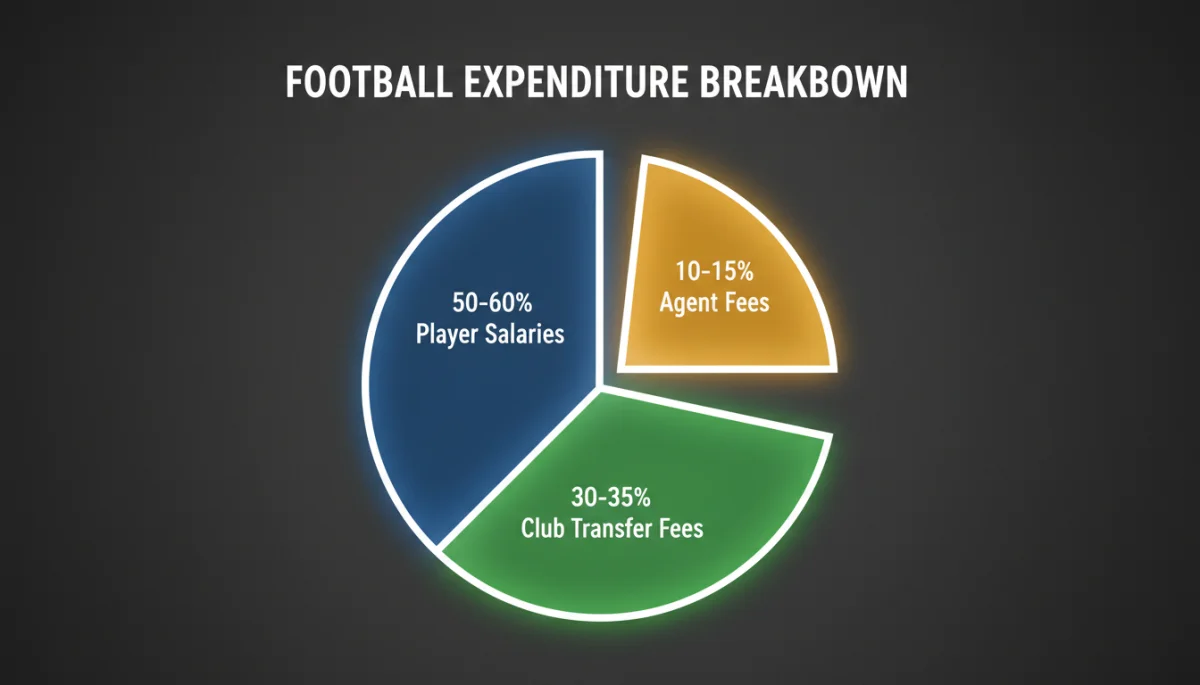
For clubs, managing agent relationships effectively is key. Building trust and clear communication with agents can lead to smoother negotiations and potentially more favorable terms. Conversely, strained relationships can complicate transfers and drive up costs. The financial implications are far-reaching, affecting transfer strategies and club sustainability.
Player welfare and agent representation
The regulations also emphasize player welfare, ensuring that agents act in their client’s best interests. This includes providing sound advice on career development, contract negotiations, and financial planning. A responsible agent is more than just a deal-maker; they are a career manager.
- Ensuring fair contract terms for players.
- Providing career guidance and planning.
- Protecting players from exploitative practices.
The financial burden of agent fees, while primarily borne by clubs, ultimately influences the entire football ecosystem. It dictates how much money is available for player salaries, transfer budgets, and overall investment in the sport. The 10-15% standard aims to create a predictable financial environment, allowing clubs and players to plan more effectively for their future.
In essence, agent fees are a critical component of football economics. Their impact reverberates through club balance sheets and player earnings, making their regulation and transparent application vital for the sport’s financial health and the equitable treatment of its participants.
Navigating contractual complexities and negotiations
Transfer negotiations are inherently complex, involving multiple stakeholders with often competing interests. Agent fees add another layer of intricacy to these discussions. Successfully navigating these complexities requires shrewd negotiation skills, a deep understanding of market values, and a clear grasp of the regulatory framework.
Agents play a pivotal role in this process, acting as intermediaries between clubs and players. Their expertise in contract law, football regulations, and market trends is invaluable. They are responsible for securing the best possible terms for their clients, whether that’s a player seeking a new contract or a club looking to acquire talent.
Key negotiation strategies for clubs and agents
For clubs, understanding an agent’s motivation and leverage is crucial. They often try to negotiate a lower percentage or structure the payment over time to ease the immediate financial burden. Agents, on the other hand, aim to maximize their client’s earnings and, by extension, their own commission, often highlighting the player’s market value and potential.
- Clear communication of expectations and terms.
- Thorough due diligence on player and agent history.
- Flexible payment structures for agent fees.
The rise of data analytics in football has also influenced negotiations. Clubs now have more sophisticated tools to assess a player’s value, which can provide a stronger basis for negotiations with agents. This data-driven approach helps to rationalize transfer fees and agent commissions, moving away from purely speculative valuations.
The art of negotiation in football transfers is about finding common ground while protecting one’s interests. With agent fees being a significant part of the overall cost, mastering these negotiations is essential for achieving successful outcomes in 2026 and beyond. It’s a delicate dance of demands and concessions, always with the 10-15% benchmark in mind.
Future outlook: potential changes beyond 2026
While the 10-15% standard for agent fees is expected to be a staple in 2026, the football world is constantly evolving, and further changes are always on the horizon. The debate surrounding agent remuneration is ongoing, and as the sport’s global economy shifts, so too might the regulations governing these transactions. Anticipating these potential changes is vital for all involved parties.
One area of continuous discussion is the effectiveness of the current fee caps. Some argue that they are too restrictive and stifle competition among agents, potentially leading to less favorable deals for players. Others contend that they are necessary to maintain financial stability and prevent excessive profiteering. This ongoing dialogue suggests that the current framework may not be the final form.
Technological advancements and their role
Technological advancements, particularly in blockchain and smart contracts, could also play a role in future transfer mechanisms. These technologies offer the promise of greater transparency and automation in payment processing, potentially reducing the administrative burden and costs associated with agent fees.
- Increased use of digital platforms for transfer agreements.
- Potential for AI to assist in player valuation.
- Enhanced data security for contractual information.
Furthermore, the global nature of football means that variations in national legislation can also influence FIFA’s universal regulations. Harmonizing these diverse legal landscapes remains a complex challenge, and any future changes will likely consider these international dimensions. The aim will always be to create a system that is fair, consistent, and adaptable.
Looking beyond 2026, the future of agent fees will likely involve a continued push for transparency, efficiency, and fairness. While the 10-15% standard provides a solid foundation, the dynamic nature of football ensures that regulatory evolution will be a constant, requiring continuous adaptation from clubs, players, and agents alike.
The role of transparency and accountability
Transparency and accountability have become cornerstones of modern football governance, particularly concerning financial transactions like agent fees. The push for greater openness is not merely an ethical consideration; it is a regulatory imperative designed to combat corruption, ensure fair competition, and protect vulnerable parties within the sport.
FIFA’s introduction of the FIFA Football Agent Regulations (FFAR) has significantly enhanced these aspects. Clubs are now often required to disclose agent commissions to relevant football associations, which in turn publish this data. This level of transparency allows for greater scrutiny from media, fans, and regulatory bodies, making it harder for illicit practices to go unnoticed.
Benefits of increased transparency
Increased transparency benefits all stakeholders. For players, it ensures they are aware of the full financial implications of their contracts and that their agents are acting in their best interests. For clubs, it creates a more level playing field, reducing the risk of being exploited by unscrupulous agents or competitor clubs engaging in unfair practices.
- Reduces potential for conflicts of interest.
- Enhances trust among all parties involved.
- Supports compliance with financial fair play rules.
Accountability goes hand-in-hand with transparency. Agents are now subject to stricter licensing requirements and disciplinary measures for non-compliance. This creates a stronger deterrent against misconduct and encourages a higher standard of professionalism within the agent community. The clearing house system, designed to process agent payments, further reinforces accountability by centralizing and monitoring financial flows.
The emphasis on transparency and accountability in 2026 transfers, especially regarding agent fees, is a testament to football’s commitment to self-regulation and integrity. It ensures that the 10-15% standard is applied fairly and that all financial dealings are conducted in an open and ethical manner, benefiting the sport as a whole.
Case studies: successful and controversial agent fee scenarios
Examining real-world examples helps illustrate the practical application and implications of agent fees. While specific details of individual deals are often confidential, general trends and publicly discussed cases offer valuable insights into how the 10-15% standard plays out in various transfer scenarios, both successfully and controversially.
Successful scenarios often involve agents skillfully negotiating a deal that benefits both the player and the club, leading to a smooth transfer and a well-deserved commission within the established range. These are typically characterized by clear communication, realistic valuations, and a focus on long-term career planning for the player. The agent’s expertise in navigating complex clauses and securing favorable terms is paramount.
High-profile transfers and their fee structures
Conversely, controversial cases frequently arise from perceived excessive fees, conflicts of interest, or a lack of transparency. These situations often lead to public outcry, regulatory investigations, and damage to the reputations of clubs and agents involved. Such controversies highlight the need for strict adherence to regulations and ethical conduct.
- Transfers where agents represented both buyer and seller, raising ethical questions.
- Deals where fees were disproportionately high compared to the player’s value.
- Instances of undisclosed payments or informal agreements.
One notable aspect is how agent fees can fluctuate based on the player’s age and contract status. A player nearing the end of their contract, for example, might command a higher agent fee as the agent’s leverage in securing a free transfer or a favorable new deal increases. Similarly, young, highly-rated talents often come with significant agent commissions due to their future potential.
These case studies underscore the dynamic nature of agent fees within the 10-15% standard. They demonstrate that while regulations provide a framework, the human element of negotiation, ethical considerations, and market forces continue to shape the outcomes of transfer deals in 2026 and beyond.
| Key Aspect | Brief Description |
|---|---|
| Fee Standard | Agent fees typically range from 10-15% of gross earnings or transfer value. |
| Regulatory Impact | FIFA regulations aim for transparency, licensing, and fee caps to control practices. |
| Club & Player Effect | Fees impact club budgets and player net earnings, necessitating careful financial planning. |
| Future Trends | Ongoing discussions and tech advancements could further refine fee structures post-2026. |
Frequently asked questions about 2026 agent fees
Agent fees in 2026 generally fall within a 10-15% range. This percentage is usually applied to a player’s gross salary over their contract duration or a portion of the transfer fee, depending on the agent’s representation.
FIFA regulations, particularly the FFAR, aim to cap agent commissions, mandate agent licensing, and increase transparency. These rules prevent excessive fees, reduce conflicts of interest, and protect player welfare, standardizing practices across the global transfer market.
While the player’s agent primarily works for the player, the agent fee is often paid by the acquiring club. However, depending on specific contractual agreements and regulations, a portion might be borne by the player, usually from their earnings.
FIFA regulations increasingly require disclosure of agent fees to national football associations, which often publish this data. While not always fully public in every detail, there’s a strong push for greater transparency to ensure accountability and prevent illicit practices.
Future changes might include further refinements to fee caps, increased use of technology like blockchain for payments, and ongoing harmonization of national and international regulations. The debate on agent remuneration continues, suggesting potential evolutionary shifts in the system.
Conclusion
The landscape of agent fees in 2026 football transfers is defined by a blend of established practices and evolving regulations, firmly centering around the 10-15% standard. This guide has illuminated the complexities, from FIFA’s regulatory interventions to the profound impact on club finances and player economics. Transparency and accountability remain paramount, ensuring that the critical role of agents is compensated fairly while upholding the integrity of the sport. As football continues to globalize and commercialize, understanding these financial intricacies will be key for all stakeholders navigating the ever-dynamic transfer market.
